
Research
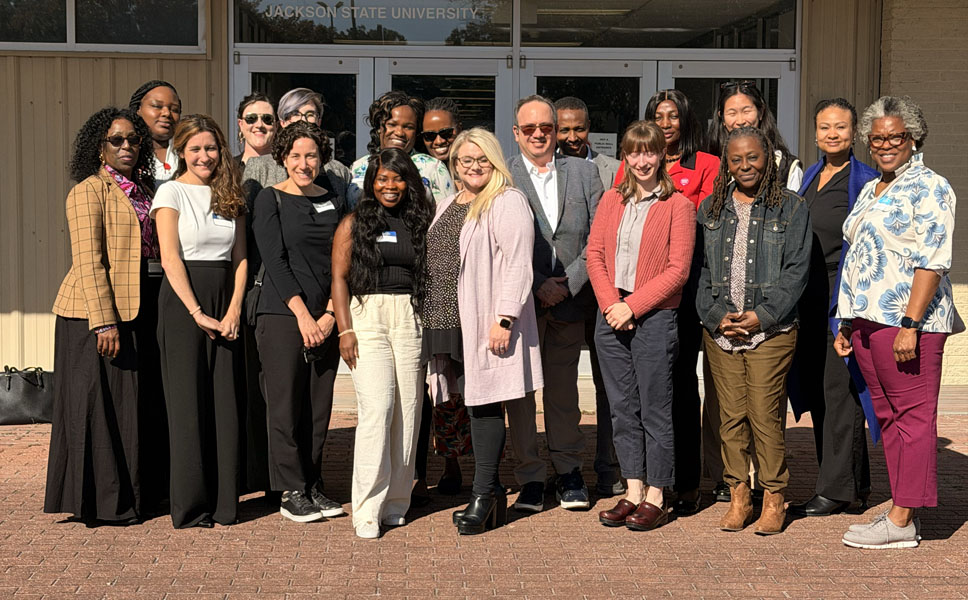
Research Project 2: Empowering Women for Postpartum Care and Reproductive Health
Research Project 2 focuses on a multilevel research approach that examines connections between postpartum women, clinical care, and supportive resources. The project explores strategies related to communication, trust, and engagement within postpartum and reproductive healthcare settings. This research is designed to generate insights that inform future approaches while maintaining strict participant protections.
Summary
The center will build on several established projects and collaborations among public, academic, and community-based partners. The proposed research projects and training program – developed through extensive meetings with all partners – are designed to provide viable solutions and successfully address maternal mortality and morbidity for women residing in the Mississippi Delta and the disparities within maternal healthcare. The first research project will develop and adapt an evidence-based community worker home visiting program that is grounded in extensive patient and community participation as well as partnerships with community organizations in healthcare, mental health, social work, and child/lactation support. The second research project will evaluate the effectiveness of a multilevel and multisectoral communication and health literacy strategy to increase trust and engagement in postpartum healthcare, through partnerships with community organizations in healthcare, economic opportunities, and health policy. Supporting the goals of the research projects, an extensive research training program for early-stage investigators will address the interpersonal and other factors that affect maternal outcomes, leveraging community partnerships with a consortium of academic and non-profit institutions supporting positive change in the Mississippi Delta.
We designed the community partnership component’s leadership team to reflect the center’s foundation in community partnership. Community partners will be co-investigators and part of the core leadership team in coordinating the research projects, trainings, conferences, community dialogues/town halls, and quarterly stakeholder update meetings. We have incorporated opportunities for community members and partners to participate in decision-making throughout all project development and implementation activities. We will ensure a successful, sustained, collaborative working environment throughout the center via the following specific aims:
Specific Aims
Aim 1 (Research Project 1): Determine the effectiveness of an evidenced-based community worker home visiting program grounded in extensive patient and community participation. This research project will determine the effectiveness of a multicomponent maternal support program – focused on physical well-being, social work, mental health, and infant care – to reduce severe maternal morbidity within populations experiencing the greatest maternal health inequities in Mississippi.
Aim 2 (Research Project 2): Evaluate the effectiveness of a multilevel patient-clinical linkage intervention to increase trust and engagement in postpartum healthcare among women in the Mississippi Delta. Our strategy will reduce structural barriers to healthcare engagement, improve providers’ patient-centered communication skills, and increase knowledge of postpartum health issues.
Aim 3 (Community Partners): Establish meaningful and equal community partnerships throughout the research development process and training. Our community partners each represent a node to a larger web of community networks, have proven histories of collaboration, and will ensure community member access to the planning, implementation, assessment, and dissemination of the research and training projects.
Aim 4 (Training): Establish a training program for early-stage investigators that addresses the interpersonal and structural factors that affect maternal outcomes. Our research training program will foster culturally responsive research that addresses maternal health disparities by training and mentoring (a) postdoctoral trainees, (b) junior faculty, and (c) other early-stage investigators in the Mississippi Delta.
As the Mississippi Delta commonly leads the nation in poor maternal outcomes, it is imperative to test and demonstrate collaboratively designed, patient-centered interventions to reduce severe maternal morbidities and close disparities for mothers in this region.
Public Health Relevance
This proposal aims to establish the Jackson State University (JSU) – Mississippi Delta Research Center of Excellence for Maternal Health to address preventable maternal mortality, decrease severe maternal morbidity, and promote maternal health in partnership with the Mississippi Delta community. This research center will conduct two multi-layered research projects utilizing community health partners, inclusive of an extensive research training program for early-stage investigators, to address the interpersonal and other factors that affect maternal outcomes. By establishing meaningful and sustainable partnerships with the community in all parts of the process, we envision that this research center will overcome social, economic, environmental, and interpersonal barriers to high-quality, culturally competent postpartum maternal care and ultimately improve maternal morbidity and mortality for women residing in the Mississippi Delta.
Project 2
PROJECT SUMMARY: Research Project 2 – Empowering Women for Postpartum Care and Reproductive Health in the Mississippi Delta
Maternal mortality and morbidity remain unacceptably high across the United States, and particularly in the Mississippi Delta, with Black women experiencing an elevated and unjust risk of loss of life and health.
Evidence supports that engagement in healthcare across the pre- and postpartum continuum can reduce adverse maternal outcomes. However, barriers to engagement in maternal healthcare persist in the Mississippi Delta, despite many attempts to intervene. Legacies and current practices have led to distrust of health advocates and healthcare providers among women in the Mississippi Delta. Poverty, transportation, lack of health insurance, poor health literacy, and limited availability of healthcare also contribute to health disparities. To improve access to care and quality of healthcare services, these well documented factors and interpersonal barriers must be acknowledged and addressed in a comprehensive manner. In this research project, we propose a multisectoral patient-clinical linkage intervention to increase comprehension, trust, and engagement in postpartum healthcare among parents in the Mississippi Delta. The intervention will directly address these documented factors and interpersonal barriers to engagement in postpartum healthcare through (a) improving health literacy and communication skills among community health workers and licensed clinicians (focusing on skills, written text and oral communication, tasks and activities for services utilization, and the environment for provision of health services); (b) community health worker care coordination to facilitate pre- and postpartum visits; and (c) employing strategies to increase insurance utilization postpartum and defray the costs of attending care. These interconnected research activities aim to reduce structural and interpersonal barriers to healthcare engagement, thereby empowering postpartum women to seek, advocate for, and receive the healthcare they deserve. This research project will implement and evaluate the proposed intervention through the following aims: (1) refine and implement the community-based patient-clinical linkage intervention and evaluate its effectiveness in increasing maternal health engagement in medical care; (2) evaluate the effectiveness of the community-based patient-clinical linkage intervention in improving health literacy and increasing trust; and (3) evaluate the effectiveness of the community-based patient-clinical linkage intervention in improving reproductive autonomy among postpartum parents in the Mississippi Delta. By providing concrete support to access information and care, we will connect parents at high risk for adverse maternal outcomes to quality preventive services. Ultimately, this research project will support the overall mission of the JSU- Mississippi Delta Research Center of Excellence for Maternal Health to empower women through increased trust and health literacy while reducing maternal morbidity and mortality in partnership with the Mississippi Delta community.
Research Project 2 – Maternal Healthcare Engagement Partners
Aaron E Henry Community Health Center has provided more than 40 years of health services, with several sites delivering comprehensive affordable healthcare, from complete primary medical care to dental services, family planning, pediatrics, public transportation, social services, nutritional education, and community outreach. The lead contact is Willie Carter, MD, Clinical Medicine Services Coordinator.
The Women and Children’s Health Initiative works as an independent consultant on maternal and child health issues. The lead contact is President Sandy Snell, MSW.
Six Dimensions is a public health research, development, and practice agency focused on supporting better health outcomes for all people and communities by creating strategies that address systemic social, health, economic, and education issues. The lead contact is Dr. Burse.
Delta Health Center is the first federally qualified community health center in the United States. Delta Health Center is located in the historic Mound Bayou, Mississippi, and offers a full range of health services along with services aimed at promoting a healthier lifestyle. The lead contact is Sandy Snell, MSW & Robin Boyle, COO.
The Southern Rural Development Center is based at Mississippi State University. The center seeks to develop and revise educational materials and maintain a centralized repository of educational resources, as well as organize and deliver high-priority rural development research and educational workshops/conferences. The point of contact is the center’s director John J. Green, PhD.
The Delta Directions Consortium is an interdisciplinary network of individuals, academic institutions, non- profit organizations, and foundations that work together to create positive social change in the multi-state Mississippi Delta Region. Goals include improving public health and promoting socioeconomic development. The Consortium is not an independent non-profit organization, but rather an alliance of partners committed to collaborativeandinnovativeproblem-solving.

Community Care Home Visiting Program
Your content goes here. Edit or remove this text inline or in the module Content settings. You can also style every aspect of this content in the module Design settings and even apply custom CSS to this text in the module Advanced settings.
Community Care Home Visiting Program
Your content goes here. Edit or remove this text inline or in the module Content settings. You can also style every aspect of this content in the module Design settings and even apply custom CSS to this text in the module Advanced settings.
Contact Us
MSDCOE Contact Form
For more information or to partner with the MSDCoE, you may reach us at:
Online
- maternalhealthcenter@jsums.edu
- Follow Us
Main Office
- 601-979-1707
- 601-979-2033
Principal Investigator
- 601-979-3103