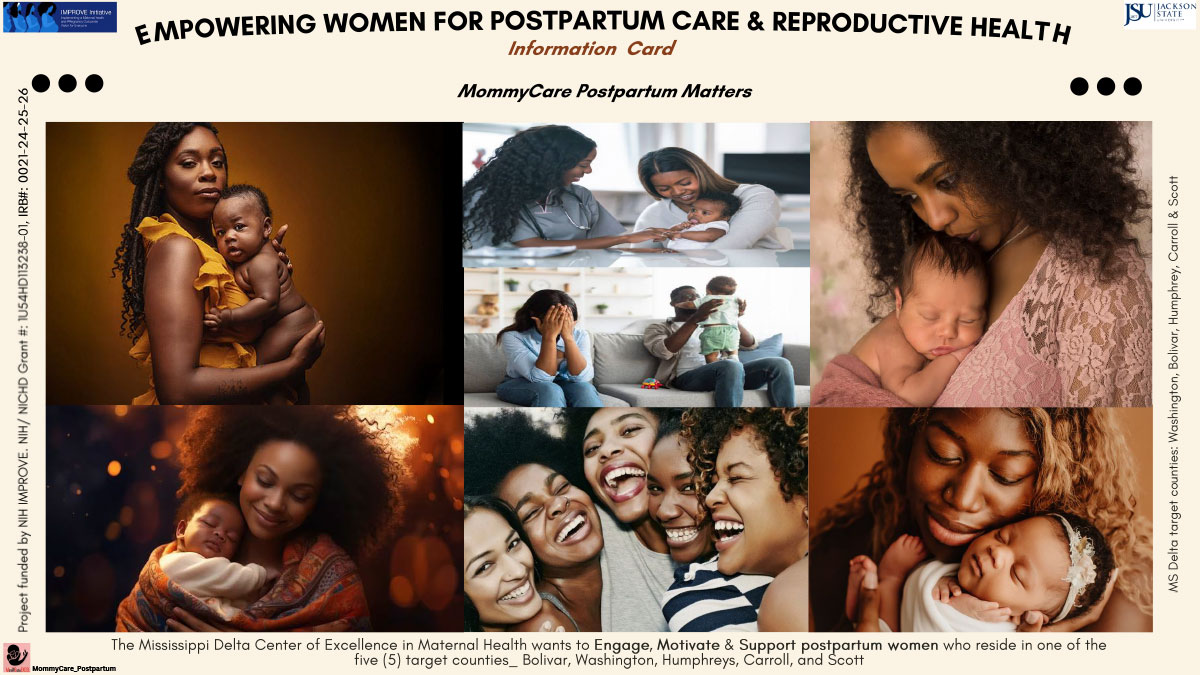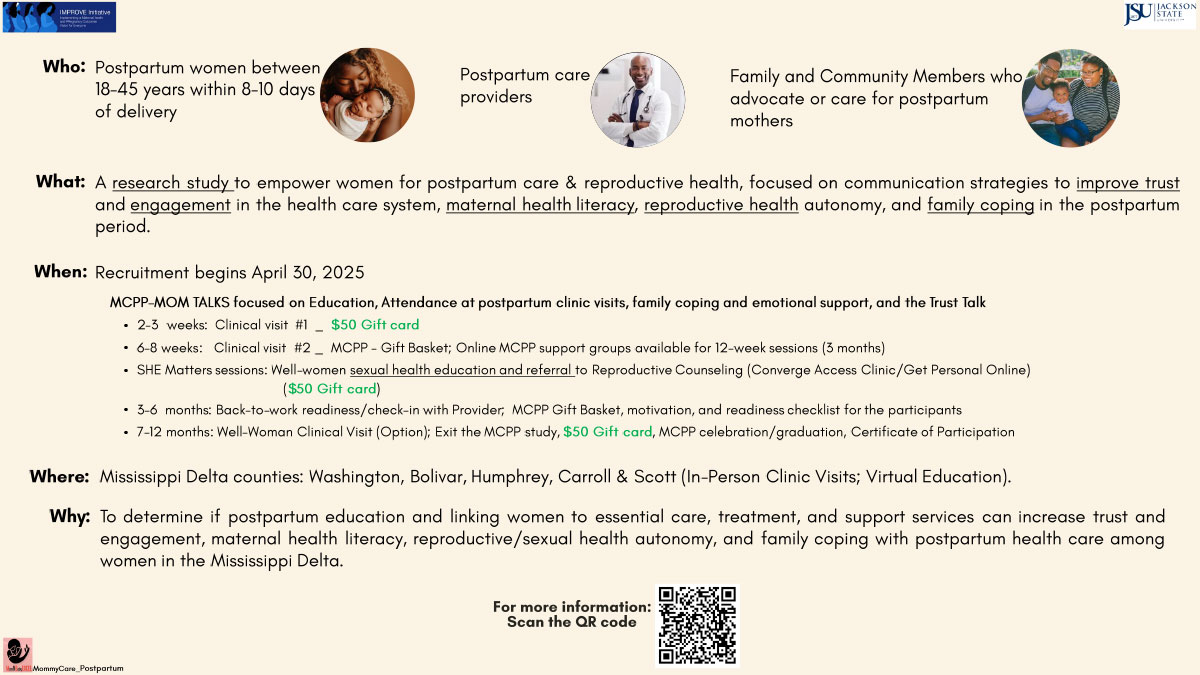
Research Project 2: Empowering Women for Postpartum Care and Reproductive Health

The Big Picture
Ultimately, this research project will support the overall mission of the JSU- Mississippi Delta Research Center of Excellence for Maternal Health to empower women through increased trust and health literacy while reducing maternal morbidity and mortality in partnership with the Mississippi Delta community.
PUBLIC HEALTH RELEVANCE
- The Jackson State University (JSU) - Mississippi Delta Research Center of Excellence for Maternal Health was established to address preventable maternal mortality, decrease severe maternal morbidity, and promote maternal health in partnership with the Mississippi Delta community.
- This research center will conduct two multi-layered research projects utilizing community health partners, inclusive of an extensive research training program for early-stage investigators, to address the interpersonal and other factors that affect maternal outcomes.
- By establishing meaningful and sustainable partnerships with the community in all parts of the process, we envision that this research center will overcome social, economic, environmental, and interpersonal barriers to high-quality, culturally competent postpartum maternal care and ultimately reduce maternal morbidity and mortality for women residing in the Mississippi Delta.
The Overarching Goal
 Evaluate the effectiveness of a multilevel patient-clinical linkage intervention to increase trust and engagement in postpartum healthcare among women in the Mississippi Delta. Our strategy seeks to reduce structural barriers to healthcare engagement, improve providers’ patient-centered communication skills, and increase knowledge of postpartum health issues.
Specific Aims/Objectives
 Aim 1: Refine and implement the community-based patient-clinical linkage intervention and evaluate its effectiveness in increasing maternal health engagement in medical care;
Aim 2: Evaluate the effectiveness of the community-based patient-clinical linkage intervention in improving health literacy and increasing trust; and
Aim 3: Evaluate the effectiveness of the community-based patient-clinical linkage intervention in improving reproductive autonomy among postpartum parents in the Mississippi Delta.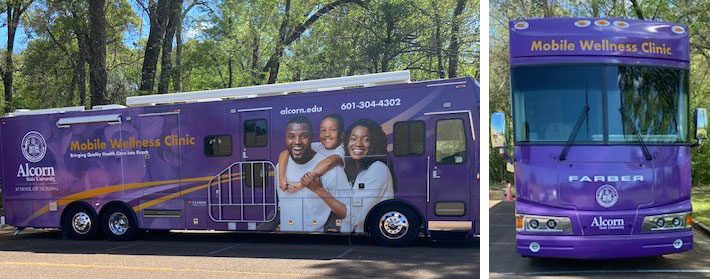
The Situation in Context
By providing concrete support to access information and care, we will connect parents at high risk for adverse maternal outcomes to quality prevention, care and support services.
Maternal mortality and morbidity remain unacceptably high across the United States, and particularly in the Mississippi Delta, with Black women experiencing an elevated and unjust risk of loss of life and health.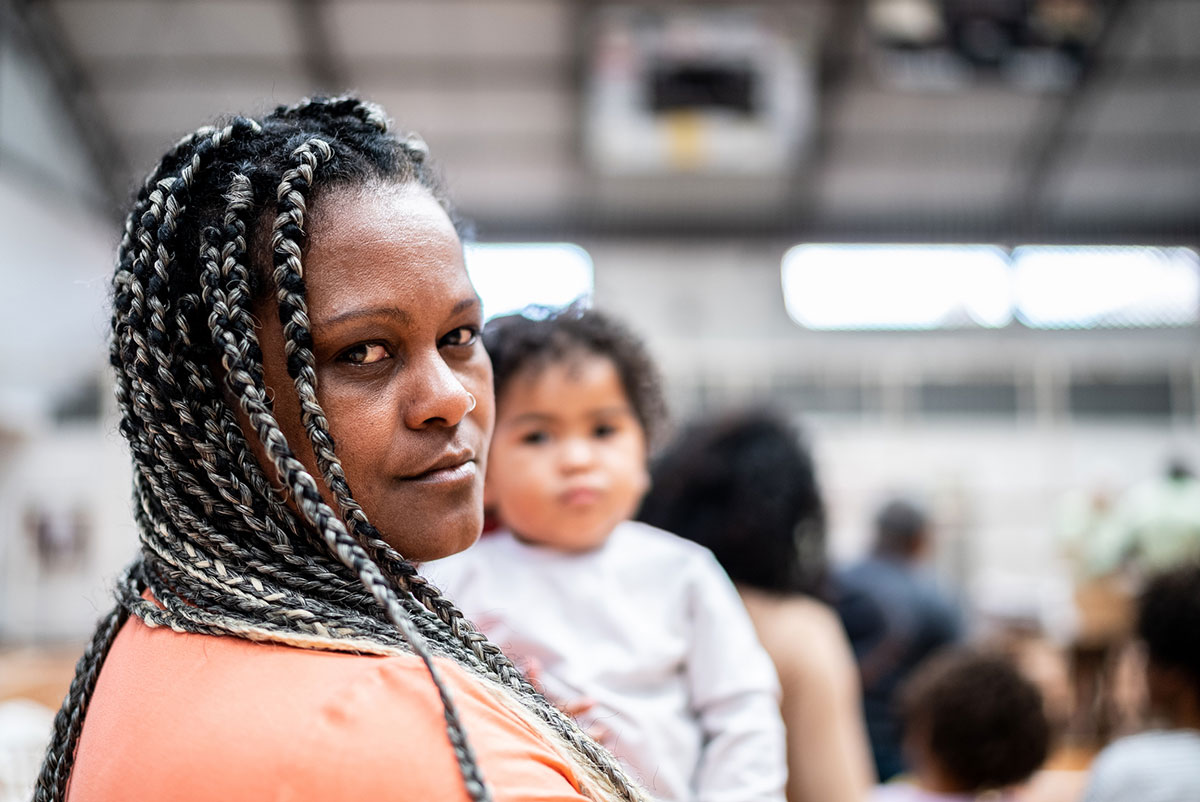
Realities to Consider
- Engagement in healthcare across the pre- and postpartum continuum can reduce adverse maternal outcomes.
- Barriers to engagement in maternal healthcare persist in the Mississippi Delta, despite many attempts to intervene.
- Legacies and questionable practices have led to distrust of health advocates and healthcare providers among women in the Mississippi Delta.
- Poverty, transportation, lack of health insurance, poor health literacy, and limited availability of healthcare contribute to poor maternal health outcomes.
- The Village that is needed to improve the conditions in which our mothers live, work, and play requires a collective effort and seamless continuum of services and support.
- The interventions will directly address cultural, structural, and interpersonal factors/barriers to engagement in postpartum healthcare.
Pearls of Hope (Online Mental Health Support Groups)
S.H.E. Matters Postpartum (Sexual and Reproductive Health Conversations)
Health Literacy Maps
Telehealth Reproductive Counseling
Insurance Infosessions
- Our interconnected research activities and partnerships aim to reduce structural and interpersonal barriers to healthcare engagement, thereby empowering postpartum women to seek, advocate for, and receive the healthcare they deserve.